


Work-based Learning (WBL) is an integral educational strategy within the Career and Technical Education (CTE) system, dating back centuries. It provides students with real-life work experiences, allowing them to apply academic and technical skills while developing crucial employability skills. These experiences occur at employer worksites, coordinated with school-based activities to illustrate the practical relevance of academic learning.
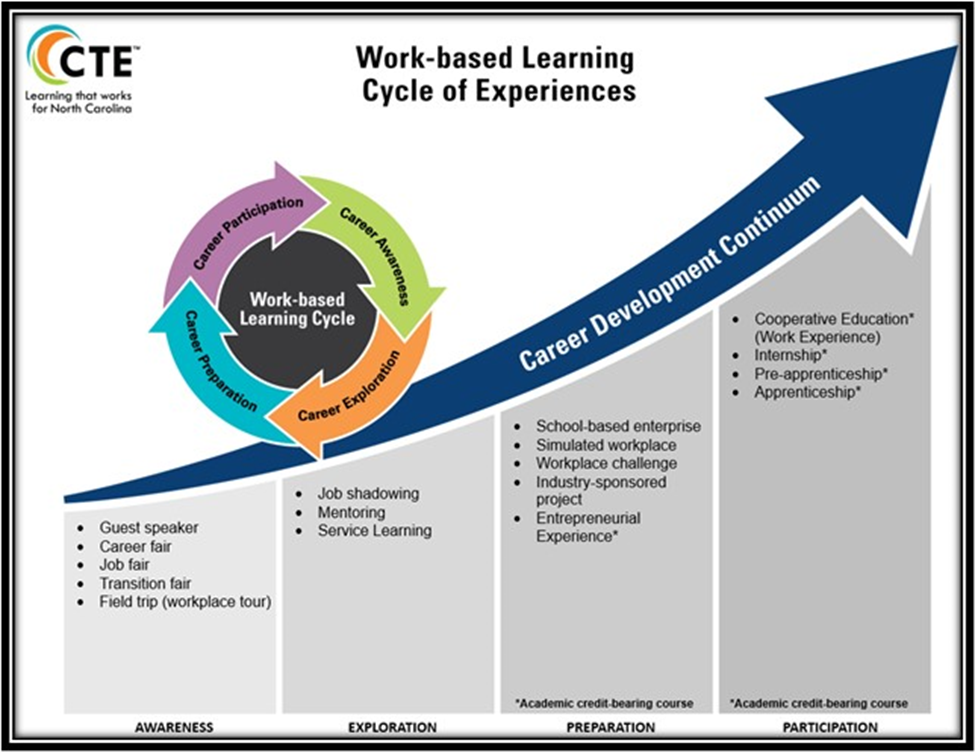
Work-based learning strategies, aligned to all CTE clusters in North Carolina, encompass the four phases of the Career Development Continuum
- Awareness
- Exploration
- Preparation
- Participation
These strategies facilitate career understanding and the development of durable employability skills and positive work attitudes. The program provides meaningful experiences aligned with the personalized career interests of individual students, emphasizing hands-on learning in real or simulated work settings. Successful implementation relies on robust partnerships between schools, colleges, and local employers.
| Benefits for Students | Benefits for Business & Industry | Benefits for Schools |
Benefit # 1 Benefit # 2 Benefit # 3 | Benefit # 1 Benefit # 2 Benefit # 3 | Benefit # 1 Benefit # 2 Benefit # 3 |
The Work-based Learning Cycle of Experiences, integrated into the Career Development Continuum, offers diverse, planned, and meaningful activities, providing students with varied opportunities to actively engage with the world of work.
To make your school experience more fulfilling and meaningful with hands-on learning, check in with your career development coordinator (CDC) for details on work-based opportunities in your area.
For general questions about work-based learning in North Carolina, please email the North Carolina Department of Public Instruction (NC DPI) Work-based Learning Consultant.